- Mar 22
The Spring Equinox: Balancing the Stress-Sleep-Gut Triangle
- Chloe Archard
- 0 comments
The spring equinox passed on Friday, equal day and equal night, and there is something about that moment in the year that I always find significant. The scales have tipped. From here, the light wins 🎉
The blackthorn is in full blossom now, the wood anemones are carpeting the floor of the woods, and along the lane by the house, the first brimstone butterflies of the year have appeared, that vivid, unmistakable sulphur yellow that feels like the countryside exhaling.
This seasonal shift isn't just poetic. It's physiological. And it creates a unique opportunity to address something that doesn't always get the attention it deserves in wellness conversations: the triangle of stress, sleep, and gut health, and how profoundly each one influences the other two.
The Triangle That Changes Everything
Here is something that most people do not fully appreciate: your gut and your brain are in constant, bidirectional conversation. The vagus nerve, the longest cranial nerve in the body, running from the brainstem all the way to the gut, carries signals in both directions. And here's the fascinating part: the gut sends considerably more signals upward to the brain than the brain sends down.
When you are under chronic stress, cortisol and adrenaline alter gut motility, increase intestinal permeability (often called 'leaky gut'), reduce digestive enzyme secretion, and shift the microbiome composition toward less beneficial species. Simultaneously, a disrupted microbiome produces fewer of the neurotransmitter precursors, particularly serotonin and GABA, that support a calm, regulated nervous system.
Each one makes the other worse.
This is why stress tends to produce digestive symptoms, and why gut imbalance so often presents alongside anxiety or low mood. The practical implication is meaningful: supporting your gut is not simply a digestive strategy. It is a nervous system strategy. The two cannot be meaningfully separated.
Why Spring Makes This Matter More
The Spring Equinox's arrival fundamentally resets your sleep patterns through increased daylight exposure. Longer days help regulate melatonin, the hormone responsible for signalling sleep, while strengthening your circadian rhythms, the body's internal biological clocks. This natural light exposure signals your body to wake earlier and feel more alert during the day, enhancing both sleep quality and overall energy levels.
But there's more. The increased sunlight during spring triggers significant neuroendocrine changes that directly reduce stress levels. Cortisol, the primary stress hormone, tends to decrease with improved sleep patterns, promoting better mood regulation. Simultaneously, serotonin, the neurotransmitter associated with wellbeing , increases due to heightened light exposure, fostering feelings of happiness and calm.
And here's where your gut comes back into the picture: your gut produces approximately 90% of your body's serotonin and 50% of its dopamine. Since spring's increased sunlight boosts serotonin production, optimising your gut health through mindful eating becomes particularly important during this season to maximise these neurochemical benefits.
The improved sleep and reduced stress from the equinox create ideal conditions for gut healing and hormone regulation. These three elements form what researchers call the "Triangle of Health", when one is optimised, the others benefit exponentially.
Gut-Supportive Eating for Stressed, Busy People
Let's talk about what this looks like in practice, because theory without application is just information.
Eat slowly and without screens where possible. Digestion begins in the mouth, and the parasympathetic nervous system (the 'rest and digest' mode) needs to be activated for optimal enzyme secretion and gut motility. Eating while stressed genuinely impairs digestion at a physiological level. I know this can feel impossible some days, life is life, but even five minutes of device-free eating makes a measurable difference.
Fermented foods daily. Kefir, live yoghurt, kimchi, or sauerkraut. Even a small serving supports microbial diversity and provides direct nervous system support via the gut-brain axis. The research here is compelling: a 2021 Stanford study found fermented foods increased microbiome diversity more effectively than a high-fibre diet alone.
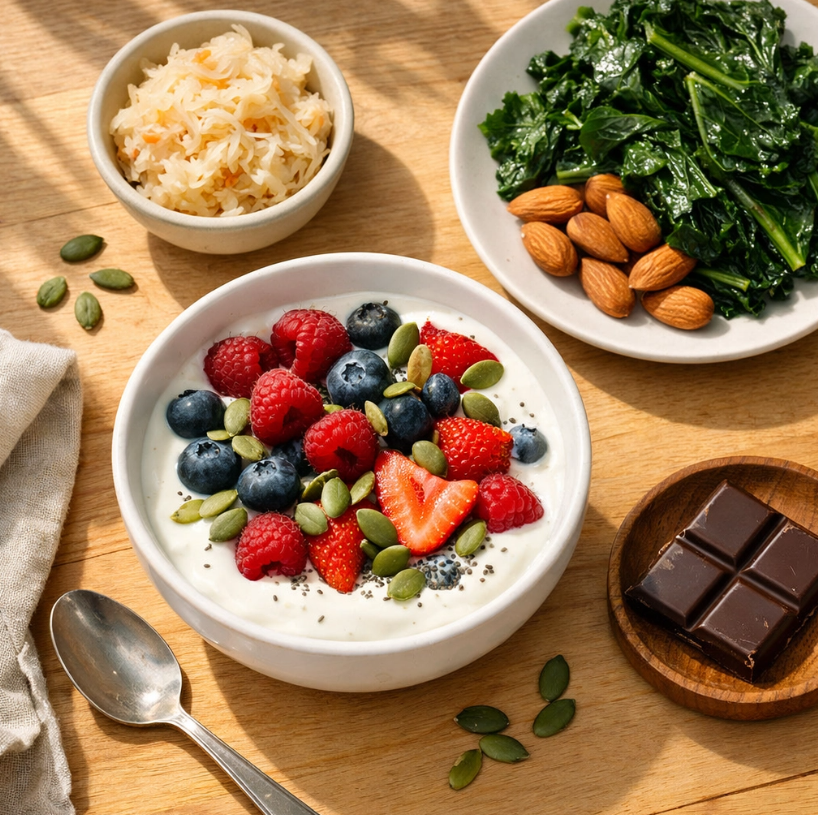
Magnesium-rich foods. Dark leafy greens, pumpkin seeds, dark chocolate, almonds, and legumes. Magnesium is depleted by stress and is essential for both gut motility and nervous system regulation.
Warm, cooked meals over raw and cold. When the nervous system is under load, the digestive system benefits from foods that are easier to process. A bowl of well-seasoned soup or a warm grain dish is genuinely easier to digest than a cold salad. This isn't about restriction, it's about meeting your body where it is.
You'll find beautiful, seasonal recipes that support all of this inside Real Food 365.

The Magnesium Missing Link
Magnesium is, in my view, one of the most important and most underappreciated nutrients in modern nutrition. It is required for over 300 enzymatic reactions in the body, plays a central role in nervous system regulation, muscle function, sleep quality, and gut motility, and it is depleted by stress, caffeine, alcohol, and many medications.
Estimates suggest that a significant proportion of UK adults are not meeting their daily magnesium requirements through diet alone.
The relevance to this week's theme is direct: magnesium activates the parasympathetic nervous system, supports the production of GABA (the brain's primary calming neurotransmitter), regulates cortisol, and - critically for gut health - is required for healthy smooth muscle contractions throughout the digestive tract. Low magnesium contributes to constipation, gut cramping, and disrupted gut motility.

For sleep specifically, magnesium glycinate / bisglycinate is the form with the strongest evidence for improving sleep onset and quality. Glycine itself has independent sleep-promoting effects, making this a particularly well-designed pairing.
I take magnesium bisglycinate every evening before bed and have done for several years. The difference in sleep quality, muscle recovery, and general evening calm is, from my personal experience, meaningful.
A note on forms: magnesium oxide, the most common and cheapest form found in high-street supplements, has poor bioavailability and is primarily useful as a laxative. Magnesium glycinate, malate, and threonate are all significantly better absorbed and better suited to the nervous system and sleep benefits described above.

Use this link for 15% discount from Time Health.
(I am an affiliate for Time Heath, but I only ever recommend brands I personally love, trust and use.)
Self-Compassion as a Health Practice
We are three weeks into Action for Happiness' Mindful March, and I want to use this moment to explore something that I think is genuinely undervalued in health and wellness: self-compassion. Not as a feel-good notion, but as a clinically studied, evidence-based practice with measurable effects on stress resilience, motivation, and long-term behaviour change.
The research from Kristin Neff and others at the Center for Mindful Self-Compassion is clear: self-compassion - treating yourself with the same kindness you would offer a good friend who is struggling - produces better outcomes in health behaviour change than self-criticism.
People who approach their setbacks with self-compassion are more likely to try again, more likely to maintain habits, and less likely to engage in all-or-nothing thinking. Paradoxically, self-compassion is not self-indulgence : it is one of the most effective motivational strategies available.
Your invitation this week: the next time you notice self-criticism arising - about your eating, your sleep, your consistency, anything - pause and ask: "What would I say to a good friend in this moment?" Then say that to yourself instead.
That is the practice. That is enough.
Spring is a season that invites growth, not perfection. The wild garlic does not emerge fully formed; it pushes up slowly, in its own time, in the conditions available to it.
So do we.
Chloe x
P.S. The clocks go forward next Sunday, 29th March. Worth preparing your sleep rhythm for gradually, moving your bedtime 15 minutes earlier over the next few evenings is considerably kinder to your circadian system than absorbing the full hour abruptly.
- £97
The Cellular Reset: Reverse Your Biological Age in 8 Weeks
- £7
Real Food 365
- £28
28-Day Revitalise
- £17